
Review of R-Ladder
The online meeting began with a reflection on the R-ladders, based on the documentation submitted by partners before the meet-up. The discussion emphasized the importance of completeness to inspire diverse approaches for reducing virgin resource use in healthcare. Key distinctions were clarified between overlapping strategies, and enthusiastically debated distinctions between the strategies. Participants noted that strategies often overlap and can be combined in practice. The group also endorsed adding a lens for product identity and ownership to each strategy, which will guide future analysis.
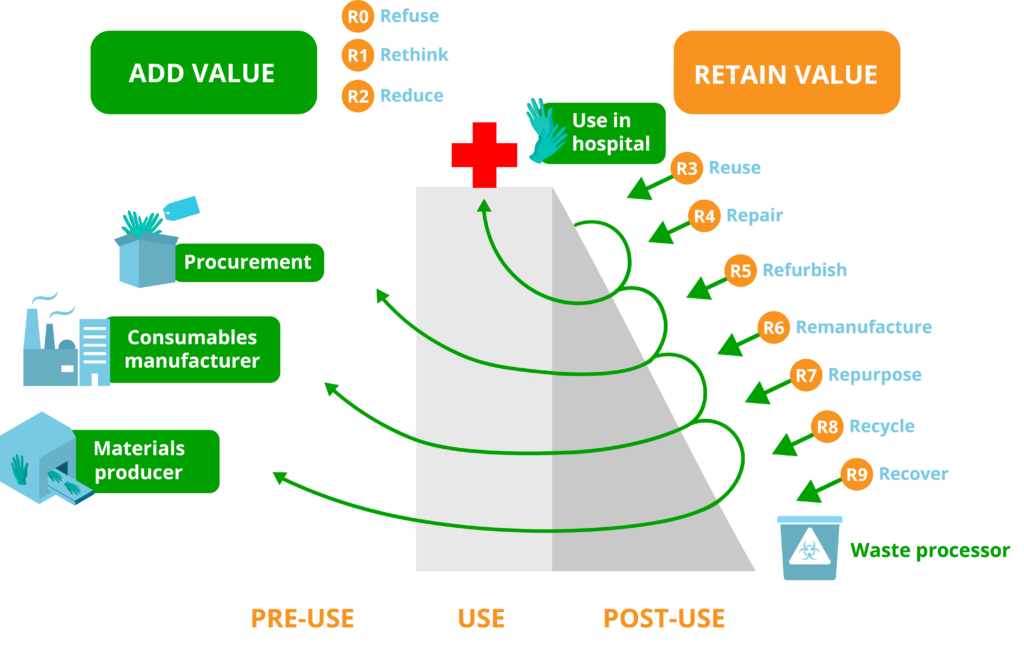
Updated Definition of Circularity
A major achievement of this meeting was the agreement on an updated and more comprehensive definition of circularity. The group recognized that the original definition focused primarily on value retention through loops of products and components. To better reflect the goals of the consortium, partners agreed to expand this definition to include resource use avoidance, keeping materials and products in use as long as possible, alongside creating multiple types of value.
This means circularity is now understood as:
“Circularity is the systematic organisation of resource use avoidance and/or value retention in loops of products, components, and raw or processed materials, with the aim of extending their lifetime and minimising the need for new (virgin) non-renewable resources and the creation of negative impacts across the entire lifecycle while maintaining or improving value in healthcare.”
Selection of Example Products for the March ’26 Co-Creation Session
To make the upcoming co-creation session tangible, the group agreed to focus on two example products: the pulse oximeter and the TAVI (Transcatheter Aortic Valve Implantation) applicator, with the related packaging. All partners expressed interest and willingness to co-create around these two products, ensuring strong engagement for the March session.
Addressing Data Gaps
The research team presented six thematic clusters of data gaps, which generated constructive dialogue and proactive suggestions from the group. Partners showed strong interest in addressing challenges such as collaboration and trust, common language and metrics, and regulatory compliance. The discussion reflected a shared commitment to transparency and innovation, with partners keen to explore practical ways to overcome adoption barriers and regulatory hurdles together.
Next steps
All partners reaffirmed their strong interest and commitment to remain actively involved in the process. Everyone expressed enthusiasm for continuing the collaboration and highlighted their willingness to co-create practical solutions. Looking ahead, there is a clear sense of anticipation for the next major milestone: the March 2026 co-creation session, where all partners will meet together to collaboratively design circular business models and procurement strategies. The group is eager to build on the momentum of this meeting and work collectively toward impactful outcomes.


